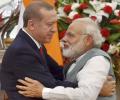
Turkish President Recep Tayyip Erdogan's has been trying to mollycoddle India with sweet nothings while having a very close relationship with Pakistan.

'How and if India retaliates will go a long way toward determining the trajectory of this crisis.'
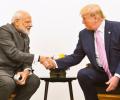
'From the Indian perspective, Trump's invitation to Imran Khan to visit the White House is a bitter pill to swallow,' points out Ambassador M K Bhadrakumar.
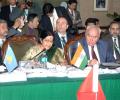
'The truly amazing part is the influence that Washington wields over Modi and the Sangh Parivar,' says M K Bhadrakumar. 'What explains it? The Americans know precisely well which raw nerve to touch and how to make the Sangh Parivar, Modi and this government perform the trapeze act.'
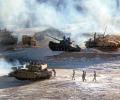
India's national security strategy needs to be revised periodically since the global and regional geopolitical situation is dynamic, points out Commodore Venugopal Menon (retd).

Modi's arrival has changed the optics of the visit. There is a different demonstration of the confidence level in the Indian leadership, but not much has changed beyond that, reports Sheela Bhatt/Rediff.com.
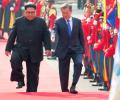
'Much depends on Moon's persuasive skill to make both Trump and Kim shed some of their rigidity and be flexible to accommodate contrarian viewpoints,' says Dr Rajaram Panda.

'It is a tense border and there are numerous elements that keep these tensions alive.' 'India is willing to militarily respond if provoked.'

December 3, 2021 marks 50 years since the beginning of the 1971 War which ended in a decisive military victory for India and the liberation of Bangladesh. Most analysts of the 1971 War agree that the IV Corps dash across the mighty Meghna river led by the brilliant General Sagat Singh was the turning point in the war, recalls military historian Colonel Anil A Athale (retd).
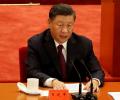
'The world does not care about the tension on our border.' 'India has to emerge as a strong economic power.' 'Respect comes when the world sees a country with a direction and leadership that has a vision,' points out Ramesh Menon.
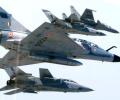
'Though the prime minister has talked somewhat needlessly of pilot projects and the real stuff to come, India cannot be sure of a clean victory in any full-fledged conflict -- even if there is reason to engage in such,' points out T N Ninan.
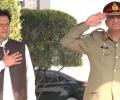
'The Modi government's grandstanding has hardened the reflexes in Beijing, Islamabad and Kathmandu and complicated India's relations with these three countries, which were even otherwise highly problematic.' 'Whatever prospects existed for a fair and balanced resolution of the territorial disputes may also have receded,' observes Ambassador M K Bhadrakumar.

With less than 24 hours to go for Pakistan NSA Sartaj Aziz's arrival in New Delhi, External Affairs Minister Sushma Swaraj told a press conference that Pakistan had only till Saturday night to give a categorical assurance on two issues.
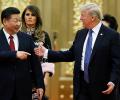
'What matters is that India's perspective on global issues -- climate change, intellectual property, free trade, trade routes being kept free, digital technology -- are listened to with respect,' says Ambassador B S Prakash.

Prime Minister Narendra Modi seems to have secured a rare concession from Pakistan that 'terrorism' and not the issue of Kashmir be the central theme of the India-Pakistan dialogue.

'I hope that the incoming Biden-Harris Administration works with India to address some of the most profound geopolitical transboundary challenges.'

New Delhi has been in 'close contact' with the Bhutan government on the unfolding developments.
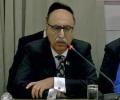
Striking a conciliatory note amid rising tension in ties, Pakistan today said it does not want to live in "perpetual hostility" with India, noting time has come for the two neighbours to decide whether status quo should continue or a new beginning be made.

The United Nations has commemorated the centenary of World War I, lauding the courage and sacrifice of soldiers including over a million from India, and underscored the importance of reconciliation through diplomacy.
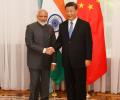
'The fact that Modi and Xi exuded confidence to accelerate the negotiations for a border settlement alone underscores that the Russia-India-China triangle has become very dynamic,' notes Ambassador M K Bhadrakumar.

While India's High Commissioner Bisaria is in Islamabad, his Pakistani counterpart Moin-ul-Haq is yet to take charge in New Delhi.
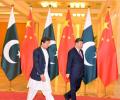
Both leaders also exchanged views on the situations in South Asia, an official Chinese statement said about the meeting between Xi and Khan.

India on Monday blamed Pakistan for "derailing" the dialogue process but said there is "no fullstop" in diplomatic relations and people always move forward after the short pauses, indicating that there may be a window for resumption of talks in near future.
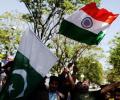
'The talks held in Bangkok, virtually on Indian terms, is an event where Pakistan seems to have blinked first.'

The outcome of the Bangkok NSA-level talks underscores that Pakistan has got exactly what it wanted -- talks at different levels, talks on Kashmir, talks on mutual concerns regarding terrorism, talks on ceasefire on the border. What if any has been India's gains remains unexplained, says Ambassador M K Bhadrakumar.
Considering the huge stakes, the Modi government is not averse to make more diplomatic efforts to see whatever it can salvage.

BJP general secretary Ram Madhav said the two neighbours needed to inject informality in their relations, as is the case in many places of the world like the EU and ASEAN.

India boycotted Pak National Day event over invitation to Hurriyat leaders.
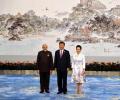
'By crudely dragging the topic into the bazaar to flog it for momentary pleasure, we turned it into a dead carcass by the time Modi even got back from Xiamen,' says Ambassador M K Bhadrakumar.

'It will make good sense for military men on that side of the table to be confronted by our own.'

'... For the India-US relationship to continue its positive trajectory, it will require India to adapt to a different approach.' Nisha Desai Biswal -- who as the Obama administration's point person for South Asia was in the inner circle of all the Obama-Modi Summits -- tells Rediff.com's Monali Sarkar why she is hopeful that India and the US are on an irreversible forward course.

'New Delhi showed itself willing -- at least for a period -- to tolerate the risk of conflict and to withstand Beijing's implicit and explicit threats.' 'But it also continued to try to cut some kind of deal with China to reduce tensions.'

Pakistani media on Monday termed the first meeting between Prime Minister Manmohan Singh and Nawaz Sharif as a "minor miracle" and noted that the dialogue held amidst a tense atmosphere yielded "words" but "no action".

India must also not rule out dialogue with Pakistan. However, talks with Pakistan must be structured, and further progress must be based on visible results.
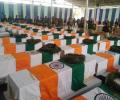
Pulwama must become the defining moment in our fight against terror, effecting a sea change in our mindset. The erratic, blow hot blow cold approach, the hallmark of our anti-terror-Pak-Kashmir policy must end. In its place is required a pragmatic, comprehensive, robust hard line course that is relentlessly pursued even in times of relative calm until the final objective is met, namely the eradication of separatism and the total annihilation of terror, says Vivek Gumaste.
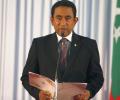
'Of course, Maldives is chicken feed for the Indian armed forces. And an intervention in the Maldives may serve the purpose of creating jingoism in an election year.' 'But from the foreign policy perspective, any such move will be a flagrant violation of international law and the UN Charter,' warns Ambassador M K Bhadrakumar.

The clichd path of conducting 'uninterrupted and uninterruptable' bilateral dialogue with Pakistan to improve ties remains unimplemented and un-implementable under prevailing circumstances that are unlikely to alter in the near future, says Rahul Bedi.
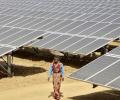
Arunabha Ghosh on why India will increasingly become an energy great power, but not an energy hegemon.

After Pyongyang tests a missile potentially capable of reaching the US, Dr Rajaram Panda explores the realistic -- and peaceful -- options before Donald Trump and the international community at large.

'India alone cannot walk the path of peace. It also has to be Pakistan's journey to make,' says Prime Minister Narendra Modi at the government's geo-political flagship initiative "Raisina Dialogue-II".
